This is a listing of notable dishes found in Russian cuisine.[1] Russian cuisine is a collection of the different cooking traditions of the Russian Empire. The cuisine is diverse, with Northeast European/Baltic, Caucasian, Central Asian, Siberian, E Asian and Centre Eastern influences.[2] Russian cuisine derives its varied character from the vast and multi-ethnic expanse of Russia.
Russian dishes [edit]
Zakuski [edit]
| Name | Image | Clarification |
| Caviar |  | Candy, salted roe, often of sturgeon[3] |
| Courgette caviar |  | Common cold entrée made of stewed vegetables (predominantly courgettes). Usually information technology is eaten with bread[4] |
| Kasha | 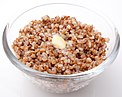 | Porridge. Buckwheat,[5] millet, oat, wheat and semolina kashas are widely pop in Russia.[6] [7] |
| Kholodets |  | A meat jelly that is also known equally studen [7] [8] |
| Stroganina |  | A dish of the indigenous people of northern Arctic Siberia consisting of raw, thin, long-sliced frozen fish. |
| Zakuski |  | Refers to a variety of hors d'oeuvres, snacks, appetizers, usually served buffet style.[9] It often includes cold cuts, cured fishes, mixed salads, kholodets, various pickled vegetables and mushrooms, pirozhki, caviar, deviled eggs, open sandwiches, canapés and breads.[9] |
| Julienne |  | Мushrooms in cream or béchamel sauce topped with grated cheese and baked in a cocotte. Chicken, fish or seafood can besides exist used with or instead of mushrooms. |
Soups [edit]
| Proper name | Image | Description |
| Okroshka |  | Common cold soup of more often than not raw vegetables similar cucumbers, spring onions, boiled potatoes, with eggs, and a cooked meat such equally beef, veal, sausages, or ham with kvass, topped with sour cream[x] |
| Rassolnik |  | A soup made from pickled cucumbers, pearl barley, and pork or beefiness kidneys[11] |
| Shchi |  | A cabbage soup.[12] Also tin can exist based on sauerkraut.[12] Kislye Shchi (sour shchi) despite its proper noun is a fizzy beverage similar to kvass, usually with honey. |
| Borscht |  | It is traditionally fabricated from meat or bone stock, sautéed vegetables, and beet sour (i.east., fermented beetroot juice). Depending on the recipe, some of these components may be omitted or substituted for. |
| Kholodny Borscht |  | Cold borscht involves use of dairy products and halves of boiled eggs. |
| Solyanka |  | A thick, spicy and sour soup that contains meat and pickled cucumbers[13] |
Sorrel soup
(green shchi) |  | H2o or broth, sorrel leaves, salt, sometimes with whole eggs or egg yolks, potatoes, carrots, parsley root, and rice[14] [15] |
| Ukha |  | A clear soup, made from diverse types of fish[16] |
Salads [edit]
| Proper name | Paradigm | Clarification |
| Dressed herring (Seld pod shuboi) |  | Diced, salted herring covered with layers of grated, boiled vegetables (potatoes, carrots, beet roots), chopped onions, and mayonnaise[17] [seven] |
| Mimosa salad | 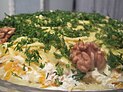 | A festive salad, whose principal ingredients are cheese, eggs, canned fish, onion, and mayonnaise[ commendation needed ] |
| Olivier salad (Stolichniy salad) |  | Diced potatoes, eggs, chicken or bologna, sweet peas, and pickles with a mayonnaise dressing. Other vegetables, such as carrot or fresh cucumbers, can exist added.[18] [7] |
| Vinegret |  | Diced boiled vegetables (beet roots, potatoes, carrots), chopped onions, and sauerkraut and/or pickled cucumbers.[19] [xx] [21] Other ingredients, such as green peas or beans, are sometimes also added.[20] [21] Dressed with vinaigrette, mayonnaise or simply with sunflower or other vegetable oil. |
Meat dishes [edit]
| Name | Paradigm | Clarification |
| Beef Stroganov |  | Pieces of sautéed beef in sauce, with smetana (sour cream)[22] |
| Craven Kiev |  | A dish made of chicken fillet pounded and rolled around common cold butter, then coated with eggs and bread crumbs, and either fried or baked. |
| Golubtsy |  | Cooked cabbage leaves wrapped around a diversity of fillings[23] [7] |
| Makarony po-flotski |  | Literally navy-style pasta, a dish made of cooked pasta (typically macaroni, penne or fusilli) mixed with stewed ground meat, fried onions and seasoned with table salt and black pepper. |
| Pelmeni |  | Dumplings consisting of a meat filling wrapped in thin, pasta dough[24] [25] [7] |
| Pozharsky cutlet |  | A breaded footing chicken patty[26] |
| Shashlyk |  | A dish of skewered and grilled cubes of meat. |
| Veal Orlov |  | A dish invented past the French[27] consisting of braised loin of veal, thinly sliced, filled with a thin layer of pureed mushrooms and onions betwixt each slice, topped with bechamel sauce and cheese. Various versions of this dish usually go by the name French-style meat in Russia today. |
Pancakes [edit]
| Name | Prototype | Description |
| Blini |  | Pancakes of various thickness and ingredients[28] [vii] |
| Oladyi |  | Small thick pancakes[29] |
Syrniki
(tvorozhniki) |  | Fried pancakes made of quark, usually topped with sour cream, varenye, jam, dearest, or apple sauce[thirty] [31] |
Bread [edit]
| Proper noun | Image | Clarification |
| Baranka |  | A dough ring somewhat smaller than a bublik, but also thinner and drier |
| Borodinsky breadstuff |  | Dark dark-brown sourdough rye bread |
| Bublik |  | A ring of yeast-leavened wheat dough, that has been boiled in water for a brusque time before baking |
| Karavai |  | A big round braided bread, traditionally baked from wheat flour and decorated with symbolic flags and figurines, such as suns, moons, birds, animals, and pine cones. |
| Kalach |  | Historically, kalach meant whatsoever kind of white staff of life, and before mod methods of grinding wheat came into use, white bread was classed as a type of fancy bread. |
| Kulich |  | One of the two sine qua non attributes of the Russian Easter (the other is Paskha).[32] A type of Easter bread.[32] |
| Sushki |  | Traditional small, crunchy, mildly sweetness bread rings eaten for dessert, ordinarily with tea or coffee |
Pirogi (pies) [edit]
| Name | Image | Description |
| Kulyebyaka |  | A fish (usually salmon or sturgeon) loaf, with rice, hard-boiled eggs, mushrooms, and dill[33] |
| Karelsky pirog |  | A traditional pirog from the region of Karelia. |
| Kurnik |  | A dome-shaped savoury blazon of Russian pirog, commonly filled with craven or turkey, eggs, onions, kasha or rice, and other optional components.[34] [35] |
| Rasstegai |  | The filling usually contains fish, but may also contain meat, liver, rice or mushrooms. |
| Pirog | 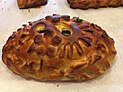 | A pie either with a sweet or savoury filling[36] |
| Pirozhki |  | Small pies[37] [vii] |
| Vatrushka |  | A pastry with a ring of dough and sugariness farmer'southward cheese in the center[38] |
Sauces [edit]
| Name | Image | Description |
| Khren |  | A spicy paste made of grated horseradish. |
| Khrenovina |  | A spicy horseradish sauce served with a main form, which is very popular in Siberia. |
| Smetana |  | A dairy production produced by souring heavy foam. |
Desserts [edit]
| Name | Image | Clarification |
| Guriev porridge |  | A Russian porridge dish prepared from semolina and milk with the addition of nuts (hazelnut, walnuts, almonds), kaimak (creamy foams) and dried fruits.[39] |
| Kutia |  | A ceremonial grain dish with sweetness gravy. |
| Paskha |  | Tvorog (farmer'south cheese) plus heavy cream, butter, carbohydrate, vanilla, etc., normally molded in the form of a truncated pyramid. Traditional for Easter. |
| Pryanik |  | A range of traditional sweet baked goods fabricated from flour and love. |
| Pastila |  | It has been described as "small squares of pressed fruit paste" and "calorie-free, airy puffs with a fragile apple flavour". |
| Varenye |  | Information technology is made by cooking berries, other fruits, or more than rarely nuts, vegetables, or flowers, in carbohydrate syrup. |
| Zefir |  | A type of soft confectionery made past whipping fruit and drupe purée (generally apple puree) with sugar and egg whites with subsequent addition of a gelling agent like pectin, carrageenan, agar, or gelatine. |
Beverages [edit]
Non-alcoholic drinks [edit]
| Proper noun | Image | Description |
| Kissel |  | Fruit dessert of sweetened juice, thickened with arrowroot, cornstarch or potato starch[40] |
| Kompot |  | Non-alcoholic sweet beverage, that may exist served hot or cold, depending on tradition and season. It is obtained by cooking fruit such equally strawberries, apricots, peaches, apples, rhubarb, gooseberries, or sour cherries in a large volume of h2o, oftentimes together with carbohydrate or raisins equally additional sweeteners. |
| Kvass |  | A fermented non-alcoholic potable fabricated from black or regular rye staff of life or dough[41] |
| Mors |  | A non-carbonated Russian fruit drinkable[42] [43] [44] prepared from berries, mainly from lingonberry and cranberry (although sometimes blueberries, strawberries, ocean buckthorns or raspberries). |
| Ryazhenka |  | Information technology is made from baked milk by lactic acid fermentation.[45] |
| Sbiten |  | A traditional Russian honey-based drink with herbs and spices[46] |
| Varenets |  | A fermented milk product that is pop in Russia.[47] [48] Similar to ryazhenka, information technology is fabricated by adding sour cream (smetana) to baked milk.[48] |
Alcoholic drinks [edit]
| Proper name | Epitome | Clarification |
| Medovukha |  | A traditional Russian honey-based drink coordinating to its counterparts of other Indo-European peoples[49] |
| Vodka |  | Information technology is composed primarily of water and ethanol, but sometimes with traces of impurities and flavorings. Traditionally it is fabricated by distilling the liquid from cereal grains or potatoes that have been fermented, though some mod brands apply fruits or sugar equally the base. |
| Kvass | | A fermented cereal-based not-alcoholic or low alcoholic beverage with a slightly cloudy appearance, low-cal-brown color and sweet-sour taste. Information technology stems from the northeastern part of Europe, where the grain production is thought to have been insufficient for beer to become a daily drink. In contempo years it has regained its original popularity, ofttimes marketed every bit a national soft potable or "patriotic" alternative to cola. |
Run across likewise [edit]
- Khrushchev dough
- Mikoyan cutlet
- List of Russian desserts
- List of Russian restaurants
- Russian candy
References [edit]
- ^ Archetype Russian Cooking, Elena Molokhovets ("A Gift to Young Housewives"), Indiana University Printing, 1992, ISBN 0-253-36026-ix
- ^ "The Earth Factbook". Cia.gov . Retrieved 27 December 2014.
- ^ Mitchell, C. (2009). Passport Russia 3rd Ed., eBook. Globe Trade Printing. p. 83. ISBN978-1-60780-027-9 . Retrieved December 23, 2017.
- ^ "Courgette caviar, recipe". FalkTime . Retrieved 2019-07-x .
- ^ Molokhovets, Eastward.; Toomre, J. (1998). Classic Russian Cooking: Elena Molokhovets' a Souvenir to Immature Housewives. Indiana-Michigan Series in Rus. Indiana Academy Press. p. 334. ISBN978-0-253-21210-8 . Retrieved Dec 23, 2017.
- ^ Goldstein, D. (1999). A Taste of Russia: A Cookbook of Russian Hospitality . Russian Life Books. p. 126. ISBN978-ane-880100-42-4 . Retrieved December 23, 2017.
- ^ a b c d e f 1000 h "Don't Miss These x Russian Dishes When Going To The Globe Cup". caspiannews.com. Nov 29, 2017. Retrieved 23 Dec 2017.
- ^ Encyclopaedia of Contemporary Russian. Taylor & Francis. 2013. p. 296. ISBN978-one-136-78786-7 . Retrieved Dec 23, 2017.
- ^ a b Schultze, Due south. (2000). Culture and Customs of Russia. Civilisation and Community of Europe. Greenwood Press. p. 65. ISBN978-0-313-31101-7 . Retrieved December 23, 2017.
- ^ Goldstein, D. (1999). A Gustatory modality of Russia: A Cookbook of Russian Hospitality . Russian Life Books. p. 125. ISBN978-ane-880100-42-iv . Retrieved December 23, 2017.
- ^ Schultze, Due south. (2000). Culture and Customs of Russia. Culture and Customs of Europe. Greenwood Press. p. 66. ISBN978-0-313-31101-seven . Retrieved December 23, 2017.
- ^ a b Wright, C.A. (2011). The All-time Soups in the World. Houghton Mifflin Harcourt. p. pt51. ISBN978-0-544-17779-vi . Retrieved Dec 23, 2017.
- ^ Sheraton, M.; Alexander, M. (2015). 1,000 Foods to Consume Earlier Yous Die: A Nutrient Lover's Life List. 1,000-- earlier y'all die book. Workman Publishing. pp. 420–421. ISBN978-0-7611-4168-half-dozen . Retrieved December 23, 2017.
- ^ Gorina, R. (1945). Russian Fare: A Pick of Recipes. New Europe Publishing Company Limited. p. 6. Retrieved Dec 23, 2017.
- ^ Meyers, P. (1978). The peasant kitchen: a return to simple, skilful nutrient. Vintage Books. pp. 97–98. ISBN978-0-394-72651-9 . Retrieved December 23, 2017.
- ^ Goldstein, D. (1999). A Gustatory modality of Russian federation: A Cookbook of Russian Hospitality . Russian Life Books. p. 51. ISBN978-1-880100-42-4 . Retrieved December 23, 2017.
- ^ Calzolaio, Scott (December xix, 2017). "What's cooking this holiday season". Milford Daily News . Retrieved December 23, 2017.
- ^ Perianova, I. (2013). The Polyphony of Food: Food through the Prism of Maslow’southward Pyramid. Cambridge Scholars Publishing. p. 137. ISBN978-i-4438-4511-iii . Retrieved December 23, 2017.
- ^ В. В. Похлёбкин, Кулинарный словарь от А до Я, статья Винегрет, изд. Центрполиграф, 2000, ISBN 5-227-00460-nine (William Pokhlyobkin, Culinary Dictionary, Tsentrpoligraf publishing house, 2000)
- ^ a b И. А. Фельдман, Любимые блюда, изд. Реклама, 1988, с. 180-186, ISBN 5-88520-031-ix (I. A. Feldman, Favourite dishes, Reklama publishing firm, 1988, p. 180-186)
- ^ a b Л. Я. Старовойт, М. С. Косовенко, Ж. М. Смирнова, Кулінарія, Київ, Вища школа, 1992, с. 218 (Fifty. I͡a. Starovoĭt, M. South. Kosovenko, Z͡h. M. Smyrnova, Kulinarii͡a (Cookery), Kyiv: Vyshcha Shkola, 1992, p. 218)
- ^ Von Bremzen, A.; Welchman, J. (1990). Please to the Table: The Russian Cookbook . Workman Pub. p. 146. ISBN978-0-89480-753-iv . Retrieved December 23, 2017.
- ^ Mack, Chiliad.R.; Surina, A. (2005). Food Civilisation in Russian federation and Central Asia. Nutrient culture effectually the earth. Greenwood Press. p. 78. ISBN978-0-313-32773-5 . Retrieved December 23, 2017.
- ^ Barber, C. (2015). Pierogi Dear: New Takes on an One-time-World Condolement Food. Gibbs Smith. p. 42. ISBN978-1-4236-4066-0 . Retrieved Dec 23, 2017.
- ^ Russian Travel Monthly: A Publication of Russian Data Services, Inc. Russian Information Services. 1994. pp. 4–5. Retrieved Dec 23, 2017.
- ^ Art & Auction. Art & Auction Mag. 2004. Retrieved December 23, 2017.
- ^ Schultze, S. (2000). Culture and Customs of Russia. Culture and Community of Europe. Greenwood Press. p. 62. ISBN978-0-313-31101-seven . Retrieved December 23, 2017.
- ^ "Meet the Man Who'southward Building a Fast-Casual Blini Empire". Food & Wine. Dec 15, 2017. Retrieved December 23, 2017.
- ^ Alone Planet Russia. Travel Guide. Solitary Planet Publications. 2015. p. pt327. ISBN978-1-74360-501-i . Retrieved December 23, 2017.
- ^ Jones, C.C. (2013). A Year Of Russian Feasts. Transworld. p. pt82. ISBN978-i-4464-8878-2 . Retrieved December 23, 2017.
- ^ Mack, G.R.; Surina, A. (2005). Food Culture in Russia and Central Asia. Nutrient civilization around the world. Greenwood Printing. p. 86. ISBN978-0-313-32773-five . Retrieved December 23, 2017.
- ^ a b Schultze, S. (2000). Civilisation and Community of Russia. Culture and Customs of Europe. Greenwood Press. p. 67. ISBN978-0-313-31101-7 . Retrieved December 23, 2017.
- ^ Vos, H. (2010). Passion of a Foodie - An International Kitchen Companion. Strategic Book Publishing. p. 158. ISBN978-1-934925-63-viii . Retrieved December 23, 2017.
- ^ Вильям Похлебкин. Кулинарный словарь, Курник. Москва: Центрполиграф, 2007, ISBN 978-5-9524-3170-half dozen (William Pokhlyobkin. The Culinary Dictionary, "Kurnik". Moscow: Centrpoligraph, 2007; in Russian)
- ^ Леонид Зданович. Кулинарный словарь, Курник. Москва: Вече, 2001, ISBN v-7838-0923-3 (Leonid Zdanovich. Culinary dictionary, "Kurnik". Moscow: Veche, 2001; in Russian)
- ^ Mack, G.R.; Surina, A. (2005). Food Culture in Russia and Cardinal Asia. Nutrient civilization effectually the world. Greenwood Press. p. 200. ISBN978-0-313-32773-v . Retrieved December 23, 2017.
- ^ Petrovskaya, One thousand.; Wayne, Grand.P. (1992). Russian Cookbook. Dover. p. 143. ISBN978-0-486-27329-7 . Retrieved December 23, 2017.
- ^ Encyclopaedia of Gimmicky Russian. Taylor & Francis. 2013. p. 136. ISBN978-1-136-78786-7 . Retrieved December 23, 2017.
- ^ Goldstein, D.; Mintz, Southward. (2015). The Oxford Companion to Sugar and Sweets. Oxford Academy Press. p. 597. ISBN978-0-19-931362-4 . Retrieved July 22, 2017.
- ^ Russian History: Histoire Russe. Academy Center for International Studies, University of Pittsburgh. 1995. pp. twenty–21. Retrieved December 23, 2017.
- ^ Molokhovets, E.; Toomre, J. (1998). Classic Russian Cooking: Elena Molokhovets' a Gift to Immature Housewives. Indiana-Michigan Series in Rus. Indiana University Press. p. 468. ISBN978-0-253-21210-eight . Retrieved December 23, 2017.
- ^ "ЭСБЕ/Морс — Викитека". ru.wikisource.org . Retrieved 23 December 2017.
- ^ SRAS.ORG. "Mors: Russian Fruit Drinkable". www.sras.org. Archived from the original on 28 August 2018. Retrieved 23 December 2017.
- ^ "CranberryJuice". NMU Languages, Literatures and International Studies . Retrieved 23 December 2017.
- ^ ГОСТ 31455-2012. Ряженка. Технические условия (International State Standard GOST 31455-2012. Ryazhenka. Specifications; in Russian)
- ^ Russian Life. Rich Frontier Publishing Visitor. 2003. p. 58. Retrieved December 23, 2017.
- ^ Goldstein, Darra (1999). A taste of Russia : a cookbook of Russian hospitality (2nd ed.). Montpelier, VT: Russian Life Books. ISBN9781880100424.
varenets.
- ^ a b translated; introduced; Toomre, annotated past Joyce (1998). Classic Russian cooking : Elena Molokhovets' A gift to young housewives (1st paperback ed.). Bloomington: Indiana University Press. ISBN978-0-253-21210-8.
- ^ Lonely Planet Russia. Travel Guide. Lonely Planet Publications. 2015. p. pt318. ISBN978-1-74360-501-i . Retrieved December 23, 2017.
Bibliography [edit]
- Curtin, Jeremiah (1909). A journey in Southern Siberia. Boston: Little, Brown and Company.
0 Response to "Beef Has Been the Traditional Meat of Russian Cuisine"
Postar um comentário