When Will I Be Able to See My Baby Kick
Why Practise Babies Kick in the Womb?
The first time a significant adult female feels her infant boot can be surprising — a sudden reminder that the tiny creature growing within her has a mind of its own. Merely why do babies kick?
Though the womb is a tight space in which to exercise, information technology turns out that those kicks are vital for the babe's healthy bone and joint development, an skillful told Live Science.
Fetuses begin moving in the womb about equally early as vii weeks, when they slowly bend their necks, according to a review newspaper published in the journal Ultrasound in Obstetrics & Gynecology. As the babies grow, they gradually add more movements to their repertoire, such equally hiccupping, arm and leg movements, stretching, yawning, and thumb sucking. But the mom won't feel the bigger movements — such as kicks and punches — until xvi to 18 weeks into her pregnancy, when the babe is a flake stronger. [In Photos: How Babies Learn]
Babies need their exercise, as well
An entire field of inquiry is dedicated to figuring out whether the infant is in control of its motion or if those movements are just a reflex, said Niamh Nowlan, a bioengineer at Imperial College London. "Early movements are likely to be purely reflex," Nowlan told Live Science in an electronic mail, but as the movements become more coordinated, "it'southward likely the brain is in control of how much and when the babe moves." (Reflexes, on the other hand, come from the spinal cord and don't require input from the brain.)
Scientists may not know for certain if the movements are voluntary or involuntary, but Nowlan said the enquiry is articulate that movement is important. "The baby needs to move [in the womb] to be good for you after birth, particularly for their basic and joints," she said. In a review she published in the journal European Cells and Materials, Nowlan described how a lack of fetal movement tin lead to a variety of congenital disorders, such every bit shortened joints and sparse bones that are susceptible to fracture.
For pregnant women wondering if their baby is as well kicky, or non kicky enough, Nowlan said there's no established amount of normal fetal move during pregnancy. "Pregnant women are told to look out for significant changes in movements, which is quite vague advice, but information technology's the best that can be given at the moment," she said.
That'south considering it's difficult for scientists to study fetal movements, because the only style to measure out them is in the hospital and it can be done for only a short menses at a time. To become around this trouble, Nowlan and her colleagues are working on developing a fetal-movement monitor that the mother tin can article of clothing during her normal daily activities. The researchers tested the monitor on 44 women who were 24 to 34 weeks meaning and could accurately detect breathing, startle movements and other general torso movements. Their results were published in the journal PLOS One in May.
One written report, published in 2001 in the journal Human being Fetal and Neonatal Motion Patterns, establish that boys may motility effectually more in the womb than girls. The boilerplate number of leg movements was much higher in the boys compared to the girls at 20, 34 and 37 weeks, that study plant. But the study's sample size was small, only 37 babies, so Nowlan and her colleagues are hesitant to claim in that location'due south a relationship betwixt gender and fetal movement.
Fetal kicks tin can pack a punch
It'due south unlikely that each woman will feel the same thing when her baby starts kick.
"Unlike women experience the awareness quite differently, and sensations tin vary betwixt pregnancies," Nowlan said. In her own two pregnancies, for case, she said she was much more sensitive to the movements of her second child compared to those of her first. "I could always tell where my son's feet were, whereas that wasn't really the case for my kickoff," she said. She hypothesized that this variation could accept arisen because the womb muscles are more stretched out subsequently the first pregnancy, a topic she'due south at present studying.
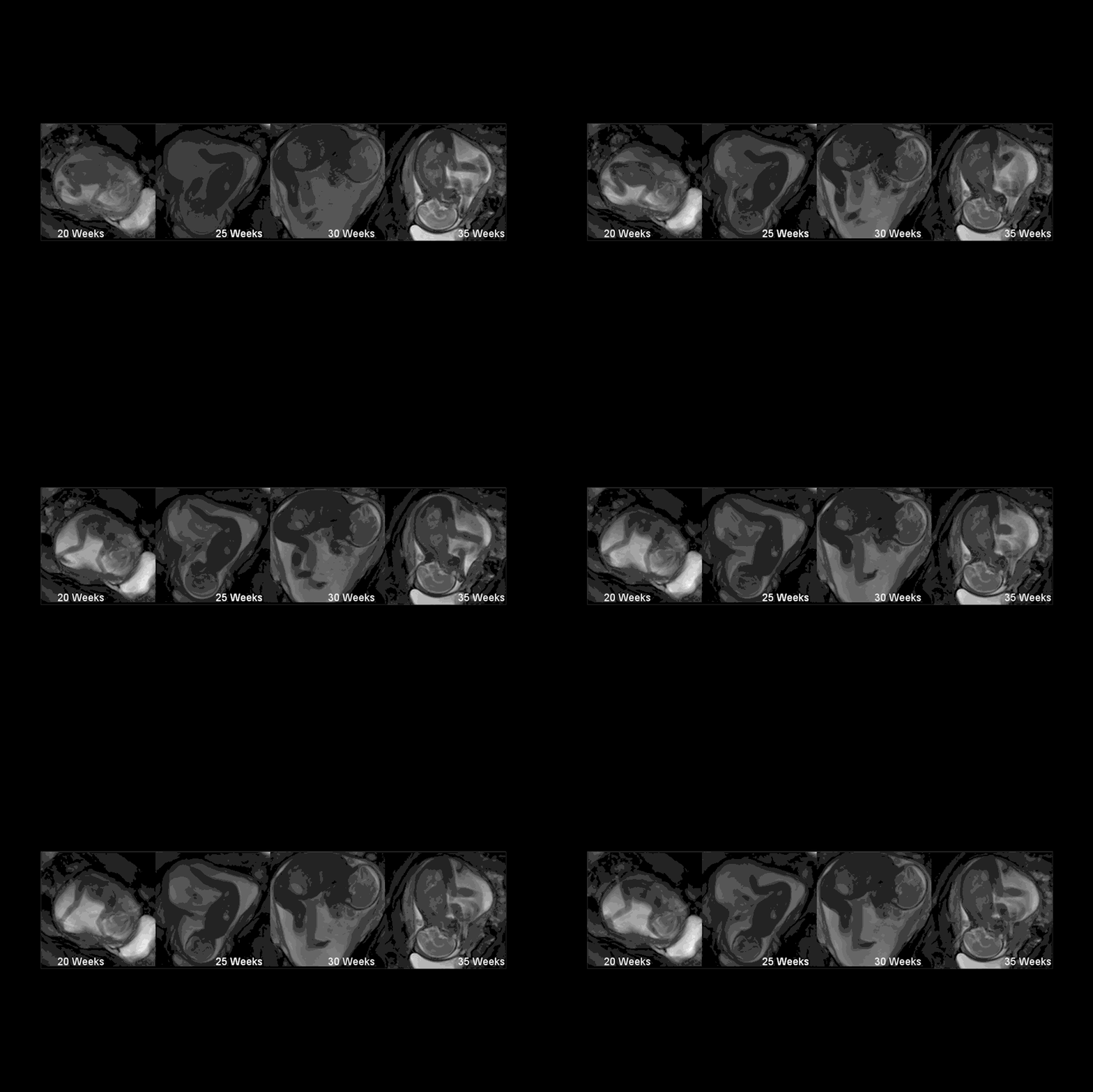
The most-pronounced movements mothers volition feel are the baby'southward kicks. A recent study from Nowlan and her colleagues, published in the Journal of the Regal Society Interface in January, plant that the impact of the baby'due south boot increases from 6 lbs. (2 kilograms) of force at 20 weeks to ten lbs. (4 kg) of force at 30 weeks. After that point, the babe'south kick forcefulness decreases to just under iv lbs. (two kg). The scientists said they suspect the decrease in movement occurs because at that place is less room for the babe to move around.
But babies in the womb are doing more than just kicking. By 15 weeks, the baby is besides punching, opening and closing its mouth, moving its head, and sucking its pollex. A few weeks after, the baby volition open and close its eyes. But the mother will feel only the major movements: kicking, punching and possibly large hiccups.
The babies likewise do "breathing movements,'" said Nowlan. While the baby isn't actually breathing air, information technology volition perform the same movement, merely with amniotic fluid. Nowlan explained that babies who don't perform this movement often have trouble breathing once they're born, because they haven't built up their chest muscles.
Feeling a baby moving and boot in the womb might be a weird sensation, just it'due south simply a sign of healthy development.
Original commodity on Live Scientific discipline.

Kimberly has a bachelor'southward degree in marine biology from Texas A&M University, a master's degree in biology from Southeastern Louisiana Academy and a graduate document in scientific discipline communication from the University of California, Santa Cruz. She is a former reference editor for Live Science and Space.com. Her work has appeared in Within Science, News from Science, the San Jose Mercury and others. Her favorite stories include those near animals and obscurities. A Texas native, Kim now lives in a California redwood wood.
Source: https://www.livescience.com/62928-why-babies-kick.html
0 Response to "When Will I Be Able to See My Baby Kick"
Postar um comentário