How Many Families Are There in the United States
Family Patterns in the United States Today
Learning Objectives
- Describe the major marriage and family arrangements in the U.s.a. today.
- Discuss racial and ethnic differences in marriage and family arrangements.
It is time now to take a closer expect at families in the U.s.a. today. Using U.Southward. demography data (U.South. Census Bureau, 2010), we start sketch the major types of family arrangements that now be.
Marriage
The census defines a household every bit being all the people who live together in a dwelling unit of measurement, whether or not they are related past blood, matrimony, or adoption. Nearly 117 one thousand thousand households be in the United States. Of this number, about 67% are family households and 33% are nonfamily households. Nearly of the nonfamily households consist of just 1 person. About half of all households involve a married couple, and half exercise not involve a married couple.
This last figure should not propose that marriage is unimportant. Only 26% of all adults (18 or older) have never been married, about 57% are currently married, x% are divorced, and 6% are widowed (run across Figure 15.2 "Marital Status of the U.S. Population, 2008, Persons eighteen Years of Age or Older"). Because more half of the never-married people are under thirty, information technology is fair to say that many of them will be getting married sometime in the future. When nosotros wait just at people aged 45–54, about 88% are currently married or had been married at some point in their lives. These figures all indicate that matrimony remains an important platonic in American life, even if not all marriages succeed.
Figure fifteen.ii Marital Status of the U.S. Population, 2008, Persons 18 Years of Historic period or Older
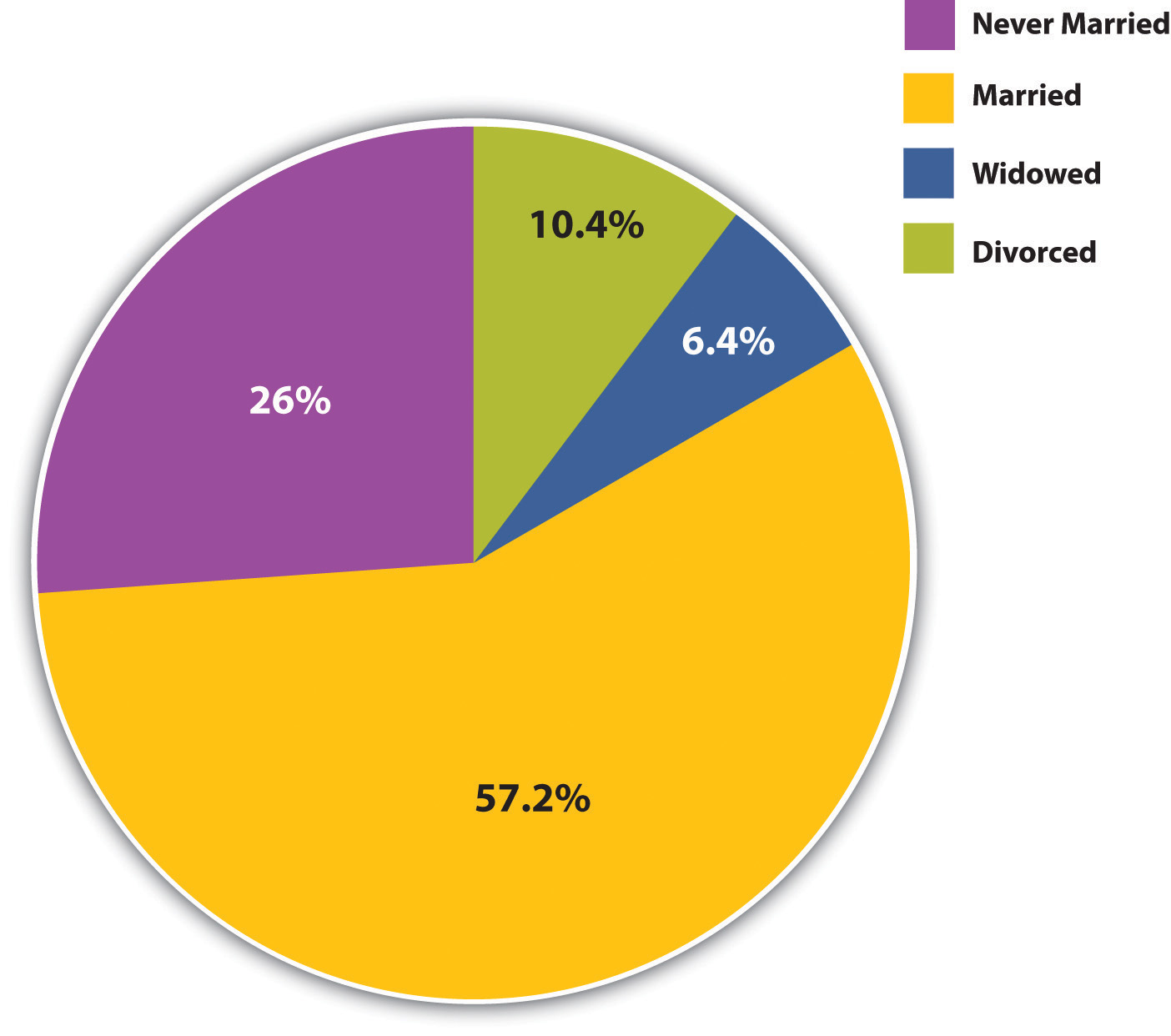
Source: Information from U.South. Census Bureau. (2010). Statistical abstruse of the United States: 2010. Washington, DC: U.S. Regime Printing Role. Retrieved from http://www.census.gov/compendia/statab.
Nigh marriages (96.ane%) are intraracial, or between people of the same race, with just 3.ix% of marriages between people of different races. Equally modest as it is, this figure is iii times greater than the 1.iii% of marriages in 1980 that were interracial. Moreover, almost 15% of new marriages in 2008 were interracial. This increase (Chen, 2010) is reflected in dating patterns, as more than half of African American, Latino, and Asian adults take dated someone from a dissimilar racial/ethnic group (Qian, 2005). More than than half of married Asians and Native Americans are in an interracial wedlock, compared to about twoscore% of Latinos, 10% of African Americans, and 4% of whites. These percentages heavily reflect the numbers of people in these groups, because mathematically it is easiest to end up in an interracial relationship and marriage if there are relatively few people in i'southward own racial/ethnic group. Considering there are so many whites compared to the other groups, more than 90% of all interracial marriages take a white spouse.
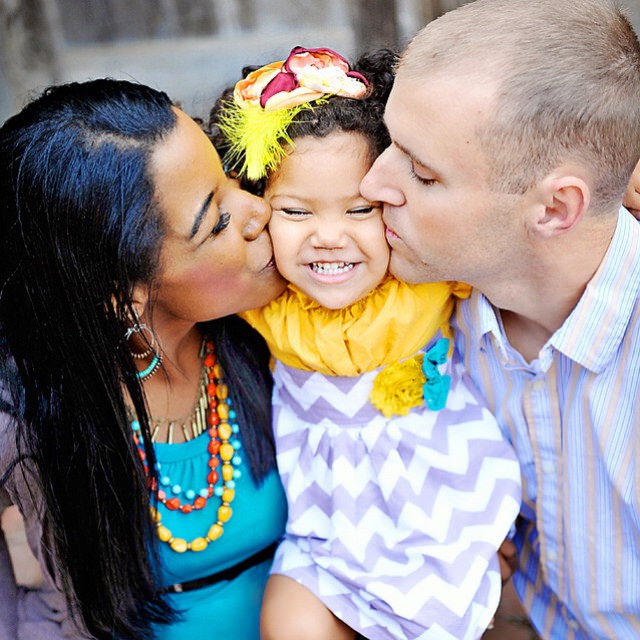
Although only 3.9% of marriages are between people of different races, this figure is three times greater than the proportion of marriages in 1980 that were interracial.
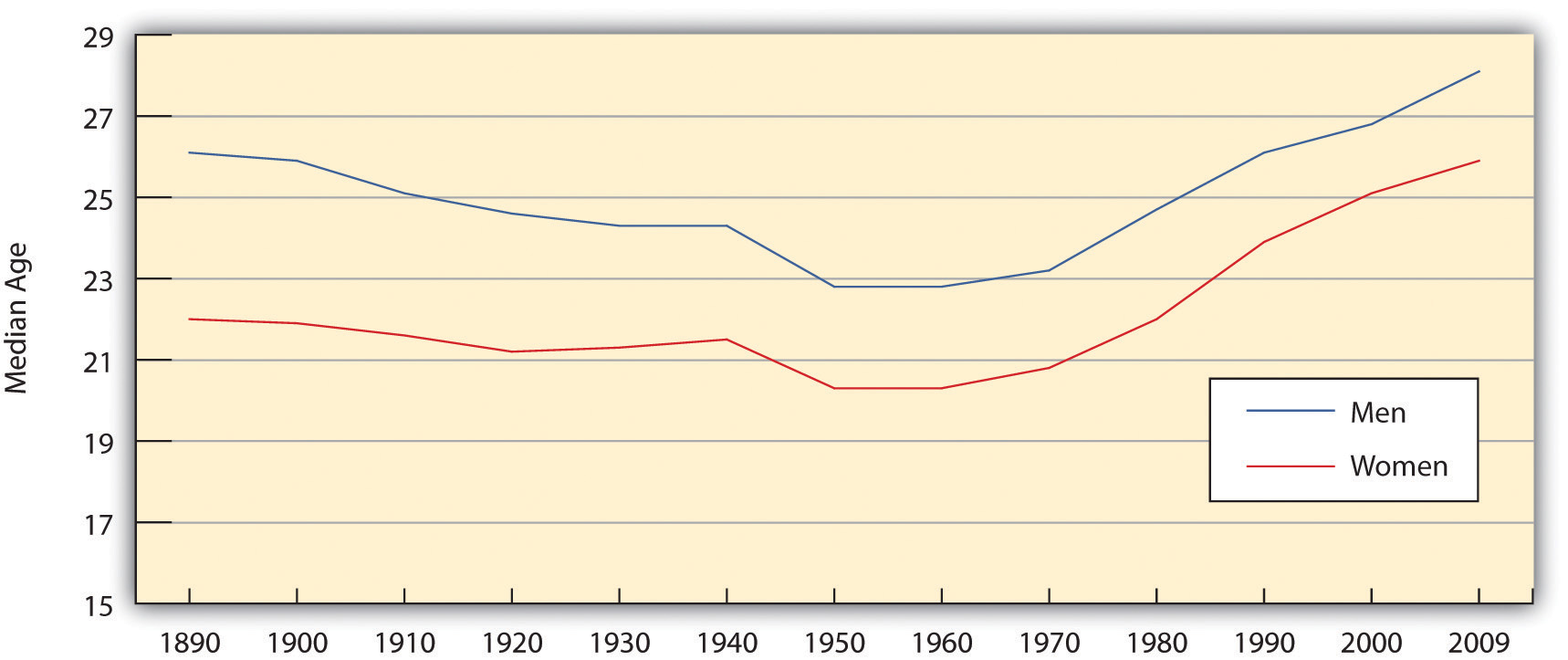
Information technology is interesting to see how the age at which people first become married has changed. Figure 15.3 "Median Age at Start Wedlock for Men and Women, 1890–2009" shows that historic period at first union declined gradually during the get-go half of the 20th century, before dropping more sharply between 1940 and 1950 because of Globe War II. It then rose after 1970 and today stands at almost 28 years for men and 26 years for women.
Effigy 15.3 Median Age at Starting time Union for Men and Women, 1890–2009
The Usa Compared With Other Western Nations
In many means, the United States differs from other Western democracies in its view of marriage and in its beliefs involving marriage and other intimate relationships (Cherlin, 2010; Hull, Meier, & Ortyl, 2010). First, Americans place more accent than their Western counterparts on the ideal of romantic dearest as a basis for marriage and other intimate relationships and on the cultural importance of marriage. Second, the United States has college rates of marriage than other Western nations. 3rd, the U.s.a. besides has higher rates of divorce than other Western nations; for example, 42% of American marriages end in divorce afterward 15 years, compared to only 8% in Italy and Spain. 4th, Americans are much more likely than other Western citizens to remarry one time they are divorced, to cohabit in short-term relationships, and, in full general, to motion from one intimate human relationship to some other, a practice called serial monogamy. This practice leads to instability that can have negative impacts on any children that may be involved and also on the adults involved.
The U.Due south. accent on romantic love helps account for its high rates of marriage, divorce, and serial monogamy. It leads people to want to be in an intimate relationship, marital or cohabiting. And then, when couples go married considering they are in beloved, many speedily find that passionate romantic dear tin apace fade; considering their expectations of romantic love were then loftier, they go more than disenchanted once this happens and unhappy in their union. The American emphasis on independence and individualism also makes divorce more likely than in other nations; if a spousal relationship is not skillful for us, we exercise what is best for usa as individuals and end the union. Every bit Andrew J. Cherlin (2010, p. 4) observes, "Americans are conflicted about lifelong matrimony: they value the stability and security of marriage, only they tend to believe that individuals who are unhappy with their marriages should exist immune to end them." Still, the ideal of romantic dearest persists even subsequently divorce, leading to remarriage and/or other intimate relationships.
Families and Children in the United States
The U.s. has about 36 one thousand thousand families with children under 18. About 70% of these are married-couple families, while 30% (upward from nigh 14% in the 1950s) are one-parent families. Most of these latter families are headed by the mother (see Figure fifteen.4 "Family Households With Children Under 18 Years of Historic period, 2008").
Figure fifteen.iv Family Households With Children Under 18 Years of Historic period, 2008
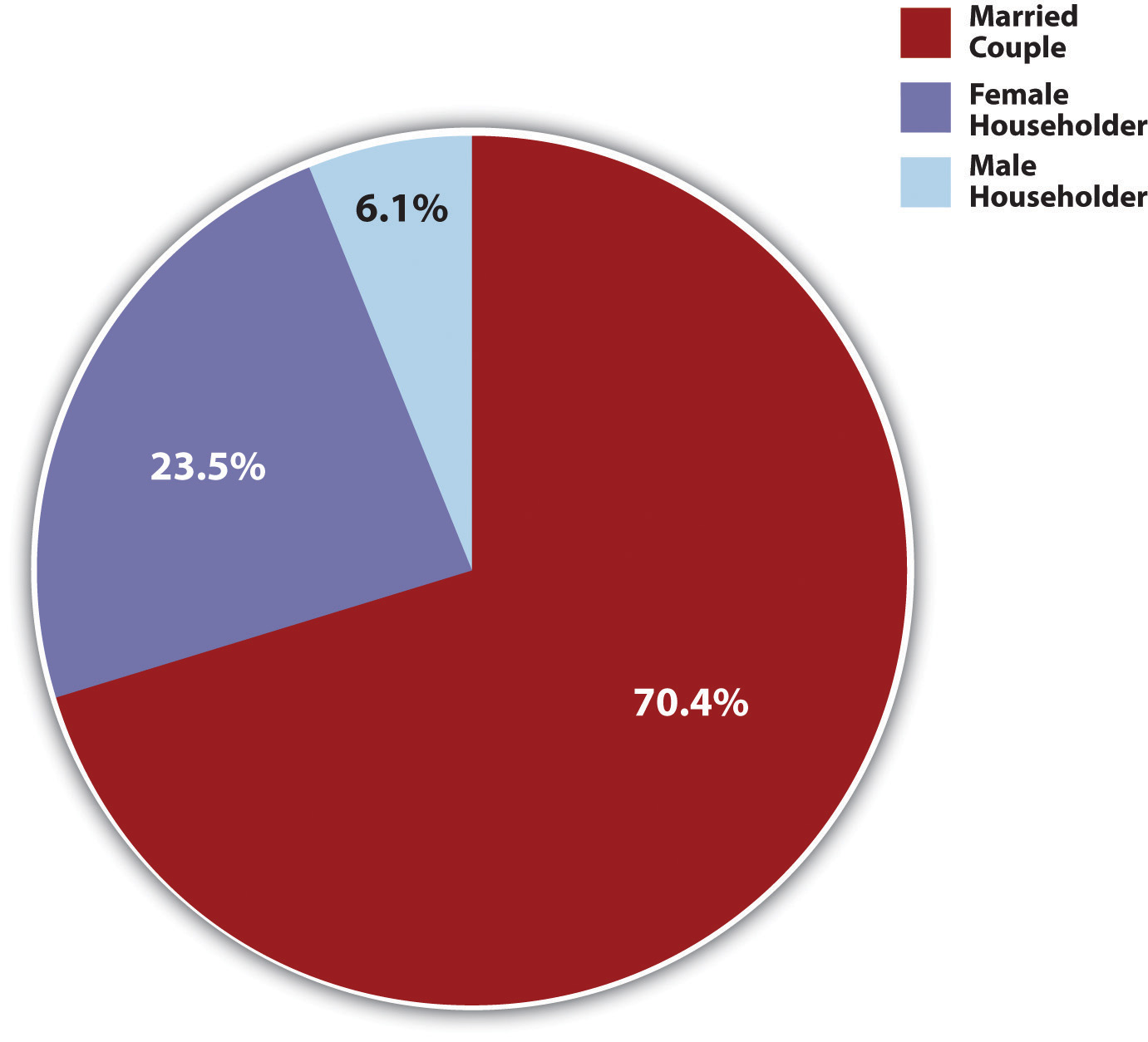
Source: Data from U.S. Census Agency. (2010). Statistical abstruse of the United States: 2010. Washington, DC: U.Southward. Regime Printing Office. Retrieved from http://www.census.gov/compendia/statab.
The proportion of families with children under 18 that have only one parent varies significantly past race and ethnicity: Latino and African American families are more than likely than white and Asian American households to accept only ane parent (run into Figure xv.5 "Race, Ethnicity, and Percentage of Family unit Groups With Only 1 Parent, 2008"). Similarly, whereas 30% of all children do not live with both their biological parents, this figure, too, varies by race and ethnicity: 22% for non-Latino white children, compared to fifteen% of Asian children, 30% of Latino children, and 62.5% of African American children.
Figure xv.5 Race, Ethnicity, and Percent of Family Groups With Simply Ane Parent, 2008
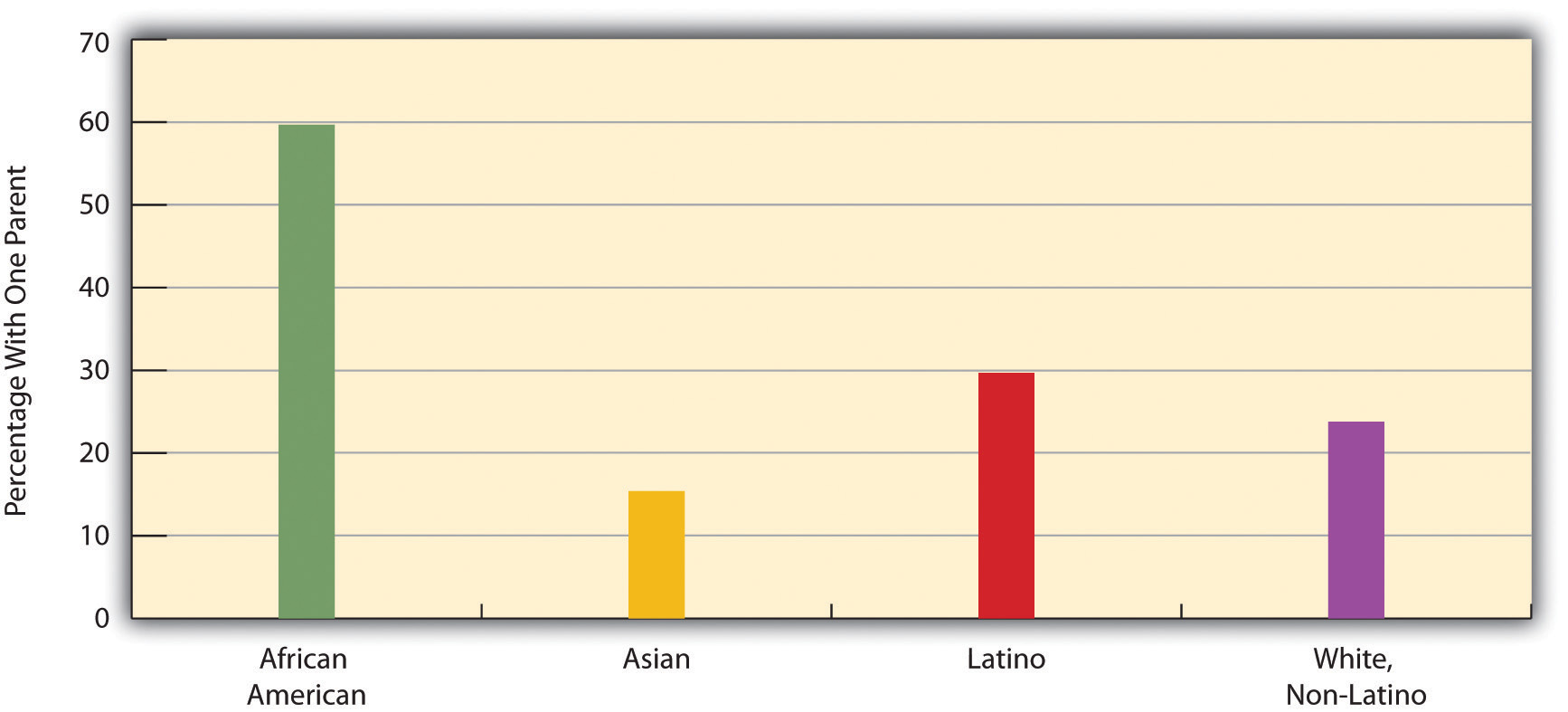
Source: Information from U.Southward. Census Agency. (2010). Statistical abstract of the U.s.a.: 2010. Washington, DC: U.S. Government Press Office. Retrieved from http://world wide web.census.gov/compendia/statab.
We hash out single-parent families and racial and ethnic differences in family arrangements at greater length a piddling later, and we will also discuss several other issues affecting children. But before we go out the topic of children, it is worth noting that children, despite all the joy and fulfillment they so often bring to parents, also tend to reduce parents' emotional well-existence. As a recent review summarized the evidence, "Parents in the Us experience depression and emotional distress more often than their childless developed counterparts. Parents of young children written report far more low, emotional distress and other negative emotions than non-parents, and parents of grown children have no ameliorate well-being than adults who never had children" (Simon, 2008, p. 41).
Children accept these effects because raising them can exist both stressful and expensive. Depending on household income, the average kid costs parents between $134,000 and $270,000 from nascence until age eighteen. College education evidently can cost tens of thousands of dollars beyond that. Robin W. Simon (2008) argues that American parents' stress would be reduced if the government provided better and more affordable day care and later on-schoolhouse options, flexible work schedules, and tax credits for diverse parenting costs. She also thinks that the expectations Americans have of the joy of parenthood are unrealistically positive and that parental stress would be reduced if expectations became more than realistic.
Key Takeaways
- Nigh people somewhen marry. This fact means that wedlock remains an important ideal in American life, even if not all marriages succeed.
- Near 30% of children live with only one parent, virtually always their mother.
For Your Review
References
Chen, S. (2010, June 4). Interracial marriages at an all-time high, study says. CNN. Retrieved from http://manufactures.cnn.com/2010-06-04/living/pew.interracial.marriage_1_ interracial-marriages-millennial-generation-race-and-ethnicity-matter?_s=PM:LIVING.
Cherlin, A. J. (2010). The marriage-get-circular: The state of marriage and the family in America today. New York, NY: Vintage.
Hull, K. E., Meier, A., & Ortyl, T. (2010). The changing mural of dearest and spousal relationship. Contexts, ix(ii), 32–37.
Qian, Z. (2005). Breaking the final taboo: Interracial spousal relationship in America. Contexts, four(4), 33–37.
Simon, R. W. (2008). The joys of parenthood, reconsidered. Contexts, vii(2), 40–45.
U.South. Census Bureau. (2010). Statistical abstract of the United states: 2010. Washington, DC: U.S. Government Printing Office. Retrieved from http://www.census.gov/compendia/statab.
Source: https://pressbooks.howardcc.edu/soci101/chapter/15-3-family-patterns-in-the-united-states-today/
0 Response to "How Many Families Are There in the United States"
Postar um comentário